
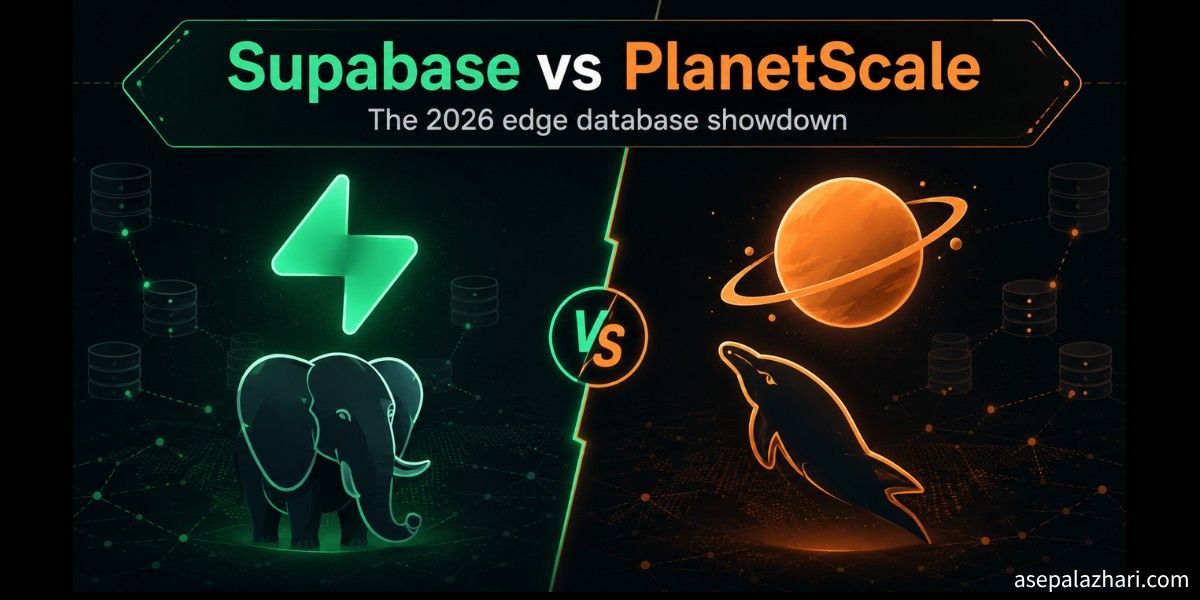
Supabase vs PlanetScale: Best Edge Database in 2026
Supabase or PlanetScale for your next project? I compare pricing, edge support, branching, and scale limits after running Supabase in production myself.
Every side project I start hits the same wall on day one. Where does the data live? A few years ago my default answer was PlanetScale, because the free tier was generous and the branching workflow felt like magic. Then April 2024 happened. PlanetScale removed its free Hobby plan, gave everyone a migration deadline, and half the indie dev world scrambled for a new home.
I moved my projects to Supabase that month and never fully left. But PlanetScale did not stand still either. It shipped Metal for raw NVMe performance and even started rolling out Postgres support, which used to be the one reason to rule it out. So in 2026 the question deserves a fresh answer. This is my honest comparison after running Supabase in production for my own projects and following PlanetScale closely since my migration.
Key Takeaways
- Supabase is the better default for solo developers and side projects in 2026. The free tier is real, the platform bundles auth, storage, and realtime, and it is plain PostgreSQL underneath.
- PlanetScale is the better choice when a revenue-generating app needs serious scale. Vitess sharding, the deploy request workflow, and Metal give it a higher ceiling, with per-instance pricing that starts at 5 dollars per month for a single node.
- PlanetScale has no free tier since April 2024. That single fact decides the comparison for most hobby projects.
- Both work at the edge through HTTP-based drivers, so Cloudflare Workers and Vercel Edge Functions can talk to either one without raw TCP connections.
What Is Supabase?
Supabase is an open source backend platform built around a full PostgreSQL database. Every project gets a real Postgres instance plus a bundle of services on top, including authentication, file storage, realtime subscriptions, edge functions, and vector search through the pgvector extension. The pitch is one platform instead of five services, and it mostly delivers.
The pricing structure is what made it the post-PlanetScale refuge. The free tier includes two projects with a 500 MB database each, and the Pro plan starts at 25 dollars per month, according to the Supabase pricing page. For a side project that may never earn a dollar, that free tier is the whole story.
What Is PlanetScale?
PlanetScale is a managed database platform built on Vitess, the sharding layer that scales MySQL at YouTube. Its signature feature is database branching. You create a branch of your schema like a Git branch, test changes there, then merge them through a deploy request with zero downtime. In 2025 PlanetScale added Metal, which runs databases on local NVMe drives for a major performance jump, and launched PlanetScale for Postgres, which now has a full lineup of instance tiers of its own.
The catch is cost. PlanetScale removed its free Hobby tier in April 2024 and never brought it back. The company was open about the reason, keeping only profitable workloads, and the product got faster and more focused afterward. Pricing is per instance now. According to the PlanetScale pricing page, a single-node PS-5 starts at 5 dollars per month, a production 3-node HA cluster starts around 15 dollars, and Metal configurations start near 50 dollars.
Supabase vs PlanetScale: Comparison Table
| Aspect | Supabase | PlanetScale |
|---|---|---|
| Database engine | PostgreSQL | MySQL with Vitess, plus Postgres |
| Free tier | Yes, 2 projects, 500 MB each | No, removed April 2024 |
| Entry paid plan | 25 dollars per month | From 5 dollars per month, single node |
| Built-in extras | Auth, storage, realtime, edge functions, vector | Database only, no bundled services |
| Schema workflow | Migrations, branching on paid plans | Branching plus deploy requests, best in class |
| Edge access | supabase-js over HTTP data API | Serverless JS driver over HTTP |
| Scaling ceiling | Vertical plus read replicas | Horizontal sharding via Vitess |
| Open source | Yes, self-hostable | Vitess is open source, platform is not |
How Do Prices Compare for a Side Project?
Supabase wins on cost for anything small. A hobby project on Supabase costs zero until it outgrows 500 MB of data. The same project on PlanetScale starts at 5 dollars per month for a single node without high availability, or around 15 dollars per month for a proper 3-node HA cluster. That is 60 to 180 dollars per year for an app that might have ten users.
The math changes for a business. Once you are paying anyway, the gap between the Supabase Pro plan at 25 dollars and a comparable PlanetScale HA cluster is small compared to what your time is worth. At that point the decision should be about engine preference, workflow, and scale, not the sticker price.
My own setup reflects this. This blog’s engagement tracking runs on a free Supabase project, and it has cost me exactly nothing for over a year. That experiment would simply not exist if the only option charged a monthly fee from day one.
Also Read: Navicat Premium 16 vs Lite: Honest Review After Switching
Which One Works Better at the Edge?
Both are edge-friendly in 2026, and they solve the problem the same way. Edge runtimes like Cloudflare Workers and Vercel Edge Functions historically could not open raw TCP database connections, so both platforms expose HTTP-based access instead.
Supabase gives you the supabase-js client, which talks to an auto-generated REST data API over HTTP. Any runtime that can fetch can query your database. PlanetScale offers its serverless driver for JavaScript, which also runs over HTTP and behaves like a normal SQL client. In my testing both add a few milliseconds over a pooled TCP connection, which is a fair trade for running everywhere.
There is one practical difference. With Supabase you can also connect over standard Postgres TCP through its Supavisor pooler when you are on a traditional server, using port 6543 in transaction mode. That flexibility matters when your stack is half edge and half VPS, which is exactly how my projects tend to end up.
What About Schema Changes and Branching?
PlanetScale still has the best schema change workflow in the industry. A deploy request diffs your schema branch, applies it with no table locks, and keeps a revert window in case the change goes wrong. Teams shipping schema changes daily feel this advantage every single week.
Supabase has closed part of the gap with its own branching feature, which spins up preview databases per Git branch on paid plans. It works, and it integrates nicely with GitHub, but it is younger and geared toward preview environments rather than safe production schema merges. For a solo developer running occasional migrations with the Supabase CLI, honestly, either approach is fine.
Which One Scales Further?
PlanetScale has the higher ceiling. Vitess was built to shard MySQL horizontally across many machines, and it is proven at YouTube scale. According to the Vitess documentation, it powers systems handling hundreds of thousands of queries per second. Add Metal with local NVMe storage and PlanetScale is the stronger answer for a database measured in terabytes.
Supabase scales the way Postgres scales, vertically first, then with read replicas. That covers the vast majority of real applications comfortably. But if your growth plan genuinely involves sharding, PlanetScale is the platform that treats it as a first-class feature rather than a future migration project.
Also Read: MySQL Gone Away: HAProxy, Galera, and Ghost Processes
Which Should You Choose in 2026?
Choose Supabase if you are a solo developer, building a side project, or want auth and storage bundled with your database. The free tier lets ideas fail cheaply, and plain PostgreSQL keeps every future migration path open. This is where I live, and I have not regretted it since 2024.
Choose PlanetScale if you run a revenue-generating product on MySQL, your team ships frequent schema changes, or you can see sharding on the horizon. The missing free tier is a filter, not a flaw. It buys the most mature schema workflow and the highest scaling ceiling in the managed database market.
The wrong reason to choose either one is engine loyalty alone. With PlanetScale adding Postgres and Supabase maturing its branching, the two platforms are converging on features. What still separates them is philosophy. Supabase optimizes for getting started, PlanetScale optimizes for staying up at scale.
Frequently Asked Questions
Does PlanetScale have a free tier in 2026?
No. PlanetScale removed its free Hobby plan in April 2024 and has not brought it back. Pricing is per instance, starting at 5 dollars per month for a single-node PS-5, so hobby projects usually still fit better on the Supabase free tier.
Is Supabase really free for small projects?
Yes, within limits. The free tier includes two projects, a 500 MB database each, and enough auth and storage quota for a small app. Free projects pause after a week of inactivity, so occasional traffic keeps them alive.
Can I use Supabase or PlanetScale with Cloudflare Workers?
Yes, both. Supabase works through supabase-js and its HTTP data API, while PlanetScale offers a serverless JavaScript driver over HTTP. Neither needs a raw TCP connection, which edge runtimes restrict.
Is PlanetScale still MySQL only?
No. PlanetScale launched Postgres support in 2025, and by 2026 it sells full Postgres instance tiers alongside its Vitess MySQL product. The Vitess side remains the most battle tested, so check feature parity before committing critical Postgres workloads to it.
Which is easier to migrate away from later?
Supabase, in my experience. It is plain PostgreSQL, so a standard pg_dump moves you to any Postgres host. PlanetScale is standard MySQL at the data level, but replacing its branching workflow and Vitess scaling takes real engineering work.
Conclusion
The 2026 verdict is simpler than the feature tables suggest. Supabase is the best starting point for solo developers and side projects because the free tier is genuine, the bundled auth and storage save weeks, and plain Postgres never locks you in. PlanetScale is the best destination for MySQL apps that make money and need to scale, with a schema workflow nothing else matches.
I run Supabase for my own projects and would still pick PlanetScale for a high-traffic MySQL product without hesitation. Pick the one that matches the stage you are in today, not the scale you dream about. Databases can be migrated, but the months you save getting started cannot be refunded.